


For crude oil refineries, feedstock flexibility is now not only an advantage but a competitive necessity. Overcoming the processing issues that a varied feedstock can bring is a challenge that must be addressed.
For refineries, diversification in the crude oil processed is increasingly essential to ensure an economical feedstock supply due to geopolitical factors and the availability of certain crudes. However, crude instability and incompatibility between different crudes increases the risk of performance issues such as sludging and fouling in key areas as well as wastewater issues.
To achieve the flexibility required to process the most economically viable portfolio of crudes, refineries need advanced insights and management tools. This is where our CrudePLUS* service can achieve significant value for refineries.
What is CrudePLUS?
The CrudePLUS Service provides actionable information from crude purchasing through to processing. It utilises advanced in-the-field rapid-response analytical testing via an Oil Fingerprinting & Solids Testing System coupled with proprietary predictive modelling software. Through this it delivers processing insights on crudes and crude blends that traditional assays or conventional titrating stability tests simply cannot. The system accurately and reliably predicts the instability, incompatibility, and fouling potential of crude oils, slop oils, other refinery fluids and their blends.
These findings allow refinery operators to reduce the risk of downstream processing issues to limit downtime, reduce maintenance requirements, lower energy costs and CO2 emissions, and maintain compliance with environmental regulations. Ultimately, CrudePLUS can help to boost profitability and increase reliability as well as maximise the use of opportunity crudes.
What characteristics does CrudePLUS analyse?
CrudePLUS testing covers four key areas:
-
Relative Instability Index (RIX): the potential of the crude to destabilise or to destabilise others in a blend (incompatibility) relative to a benchmark value.

-
Crude Precipitant Index CPI: a measure of the potential amount of precipitant of asphaltenes and other related colloids upon destabilisation. CPI is a function of RIX and the level of available precipitants.
-
Blending order: The order in which two or more fluids are blended has a direct impact on the actual degree of incompatibility and precipitant amount.
-
Fouling Potential Index (FPX): quantifies the fluid fouling potential by combining crude fluid characteristics and solids differentiation. The FPX is classified into severity regions from low to high severity.
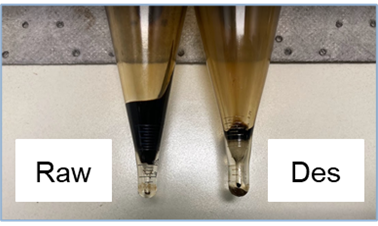 Raw crude and crude before desalter, after FPX analysis
These four factors give refinery operators a wide-ranging view of the characteristics of crudes and blends to make informed purchasing and processing decisions.
How can CrudePlus be utilised?
Depending on the requirements of the refinery, CrudePLUS can be used at different levels of integration and sophistication - as a reactive, proactive or strategic management tool.
Reactive
At this level, CrudePLUS can be used as a monitoring tool that detects processing issues and indicates a course of action. The operator team can then take specific actions to mitigate the issues, such as adjusting the crude stabiliser injection dosage.
Proactive
When used proactively, CrudePLUS functions as a simulation tool as well as monitoring the process. It allows a blending plan to be simulated based on testing of crude samples to assess multiple blend scenarios. This helps to identify the blending approach, including any chemical mitigation, that will minimise the risk of processing issues.
Strategic
CrudePLUS can be used to enhance crude purchasing decisions. This offers the highest level of value for refineries as it allows potential processing issues associated with specific opportunity crudes or blends to be addressed. CrudePLUS gives refineries the ability to test, rate and discriminate crudes and the opportunity to make crude purchasing decisions with clear benefits for the business, such reducing costs by driving discounts.
For example, many ‘dumbbell’ crudes are created and sold matching the API gravity, Total Acid Number (TAN) and sulphur specifications of a specific crude oil. While it may enter the refinery crude system under that name, it will often have very different yield and fluid characteristics. This means that using the name of the crude it replicates is ineffective for predicting how it will blend and behave during processing. With CrudePLUS, the exact characteristics of the crude can be ascertained, and an informed decision can be made. Refineries can effectively identify and avoid a problematic crude. Alternatively, they may choose to purchase and process it, but with a full understanding of the possible issues and level of mitigation that will be required.
A practical example of CrudePLUS is its implementation at a European refinery aiming to improve energy efficiency and reduce CO₂ emissions while processing an increasingly diverse crude slate. Using predictive modelling, advanced crude analysis and a tailored chemical strategy, the refinery reduced crude preheat fouling by more than 50%, improving heat transfer efficiency while lowering fuel gas consumption (>570 T) and CO₂ emissions (>1500 T). This case demonstrates how predictive crude management with a tailored chemical additive strategy can enhance operational reliability, reduce operating costs and support sustainability objectives.
CrudePLUS is an effective tool for minimising the processing issues associated with crude oil variability, such as sludging and fouling. From monitoring to strategic decision making CrudePLUS offers a wide range of opportunities for refineries to improve profits, minimise performance issues, reduce energy usage and enhance sustainability.
If you would like to discover how CrudePlus can support your refinery operations, please contact our experts today.
*Trademark of Veolia; may be registered in one or more countries.